HMRC Tax Codes — Master Reference Guide
Last updated 11/06/2026
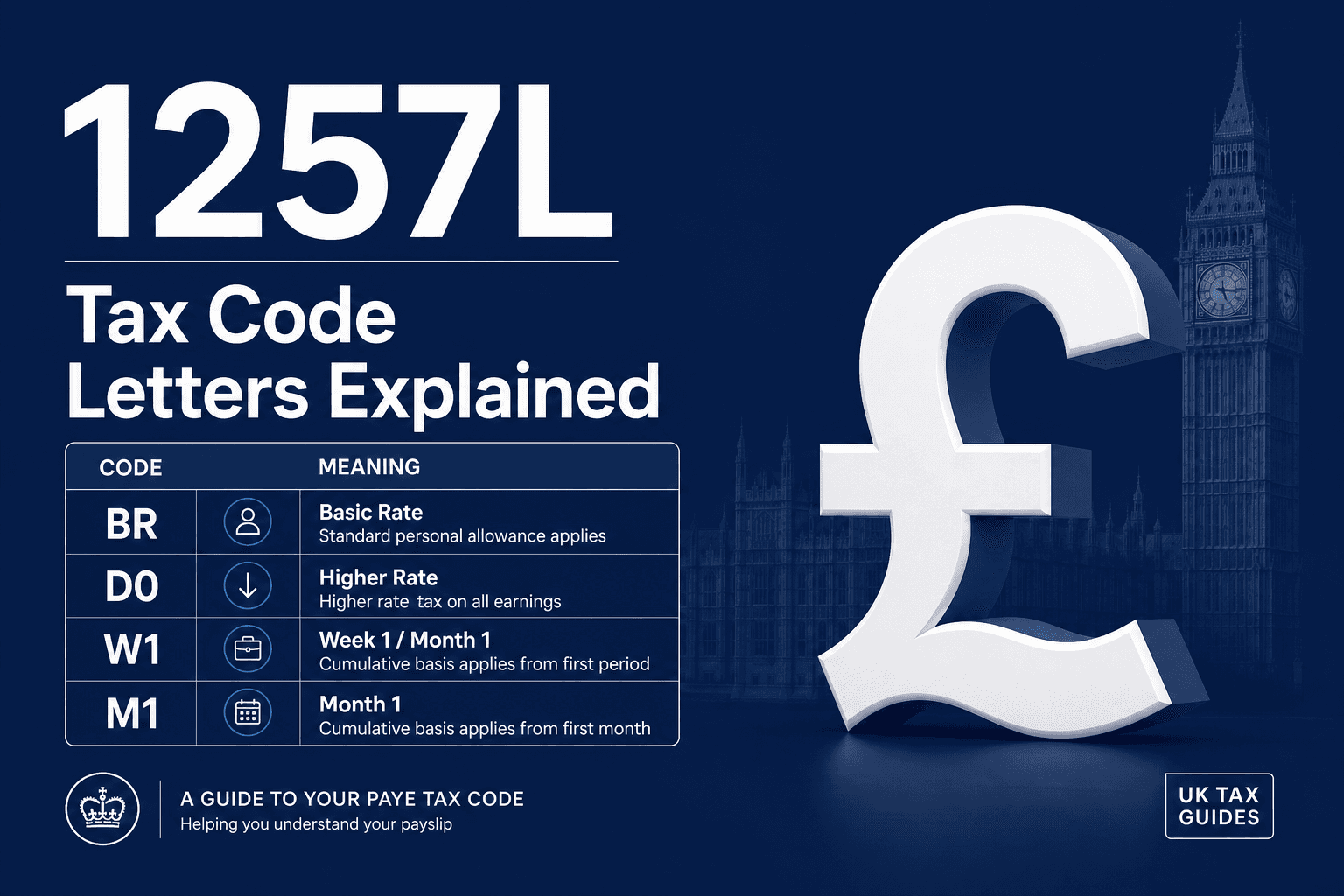
Every UK taxpayer has a tax code. It appears on your payslip, your P60, and any coding notice HMRC sends you. It tells your employer exactly how to calculate the income tax to deduct from your pay. Understanding yours means you can spot errors before they cost you money.
The Standard Code: 1257L
The most common code for 2026/27 is 1257L. The number (1257) multiplied by 10 gives your tax-free personal allowance: £12,570. The letter (L) means you receive the standard Personal Allowance.
If your code is 1257L, your employer gives you £12,570 of tax-free income per year, then deducts 20% on the next £37,700, 40% on the next £74,870, and 45% above £125,140. It operates on a cumulative basis — looking at your total pay from 6 April to date.
How the Number Is Calculated
Your personal allowance of £12,570 appears as 1257 in your code (the last digit is dropped). But your actual code number may be higher or lower based on adjustments:
- Higher number (e.g. 1383L) — you have additional allowances, such as Marriage Allowance received from a partner (1257 + 126 = 1383)
- Lower number (e.g. 1100L) — your allowance has been reduced, typically because of taxable benefits in kind (company car, private health insurance) or a prior-year tax debt being collected
- Zero (0T) — your entire allowance has been used up or HMRC has no information about you
Tax Code Letters — Complete Reference
| Letter(s) | Meaning | Common cause |
|---|---|---|
| L | Standard Personal Allowance | Most employees |
| M | Marriage Allowance received (10% of partner's allowance) | Spouse/partner earns below £12,570 and has transferred allowance to you |
| N | Marriage Allowance given away | You have transferred 10% of your allowance to your partner |
| T | HMRC needs to review your circumstances | Complex situation, income over £100,000, or annual code review required |
| BR | Basic rate (20%) on all income, no personal allowance | Second job or pension where allowance is used elsewhere; also used as emergency code |
| D0 | Higher rate (40%) on all income, no personal allowance | Second income source taxed at higher rate |
| D1 | Additional rate (45%) on all income, no personal allowance | High earners with multiple income sources |
| NT | No tax deducted | Non-UK residents under Double Taxation Agreement; specific HMRC exemptions |
| 0T | No personal allowance; all income taxed at applicable rate | New starter with no P45 and no Starter Checklist; income above £125,140; emergency code |
| K | Negative allowance — taxable income is increased, not decreased | Benefits in kind exceeding allowance; underpaid tax from prior years; state pension exceeding allowance |
| S prefix | Scottish income tax rates apply | Main home in Scotland |
| C prefix | Welsh income tax rates apply | Main home in Wales (currently same rates as England) |
| W1 suffix | Week 1 basis — non-cumulative, weekly pay | Emergency code; also used at start of employment pending P45 |
| M1 suffix | Month 1 basis — non-cumulative, monthly pay | Same as W1 but for monthly-paid employees |
| X suffix | Non-cumulative basis (no specific period defined) | Used when pay frequency is irregular |
K Codes in Detail
A K code means you have deductions (benefits, prior debts) that exceed your Personal Allowance, so HMRC adds a notional amount to your income rather than giving you an allowance. For example, K497 means £4,970 is added to your taxable income each year.
The 50% legal cap means your employer can never deduct more than half your gross pay in a single pay period, no matter how large the K code is. This protects you from unaffordable deductions, though the uncollected tax will be carried over to the next period.
Cumulative vs Non-Cumulative Codes
Most codes are cumulative (no W1/M1/X suffix). Your employer looks at your total pay and total tax since 6 April and adjusts each payslip to ensure the correct tax is deducted for the year overall. This self-corrects mid-year underpayments and overpayments automatically.
Non-cumulative codes (W1, M1, X) treat each period independently. They are used when HMRC does not have enough information to calculate a cumulative position — typically at the start of a new job before your P45 is processed. They almost always result in overpayment, especially if you had income earlier in the year.
The Personal Allowance Taper
Your allowance reduces by £1 for every £2 you earn above £100,000. This is reflected in your code number. For income of £115,000, the reduction is £7,500 (half of £15,000 above £100,000), leaving a personal allowance of only £5,070 — represented as code 507L. At £125,140 or above, the allowance is zero and your code becomes 0T.
The marginal income tax rate in the £100,000–£125,140 band is effectively 60% because each additional pound of income both attracts 40% tax and removes 50p of allowance (which is also taxed at 40%). Pension contributions or charitable donations can bring your adjusted net income below £100,000 and restore the full allowance.
What to Do If Your Code Is Wrong
- Check your current code on your Personal Tax Account on gov.uk
- Review any P2 coding notice HMRC has sent you — it explains how the code was calculated
- Update your personal details (address, benefits, employment changes) in your Personal Tax Account
- If the code is still wrong, call HMRC on 0300 200 3300 (Mon–Fri 8am–6pm)
- Use our tax code checker to see what your code means and what take-home pay it implies
If you have overpaid because of a wrong code, HMRC will issue a P800 refund notice after the tax year, or you can claim earlier via your Personal Tax Account.