The UK Personal
Allowance Explained
Last reviewed: April 2026
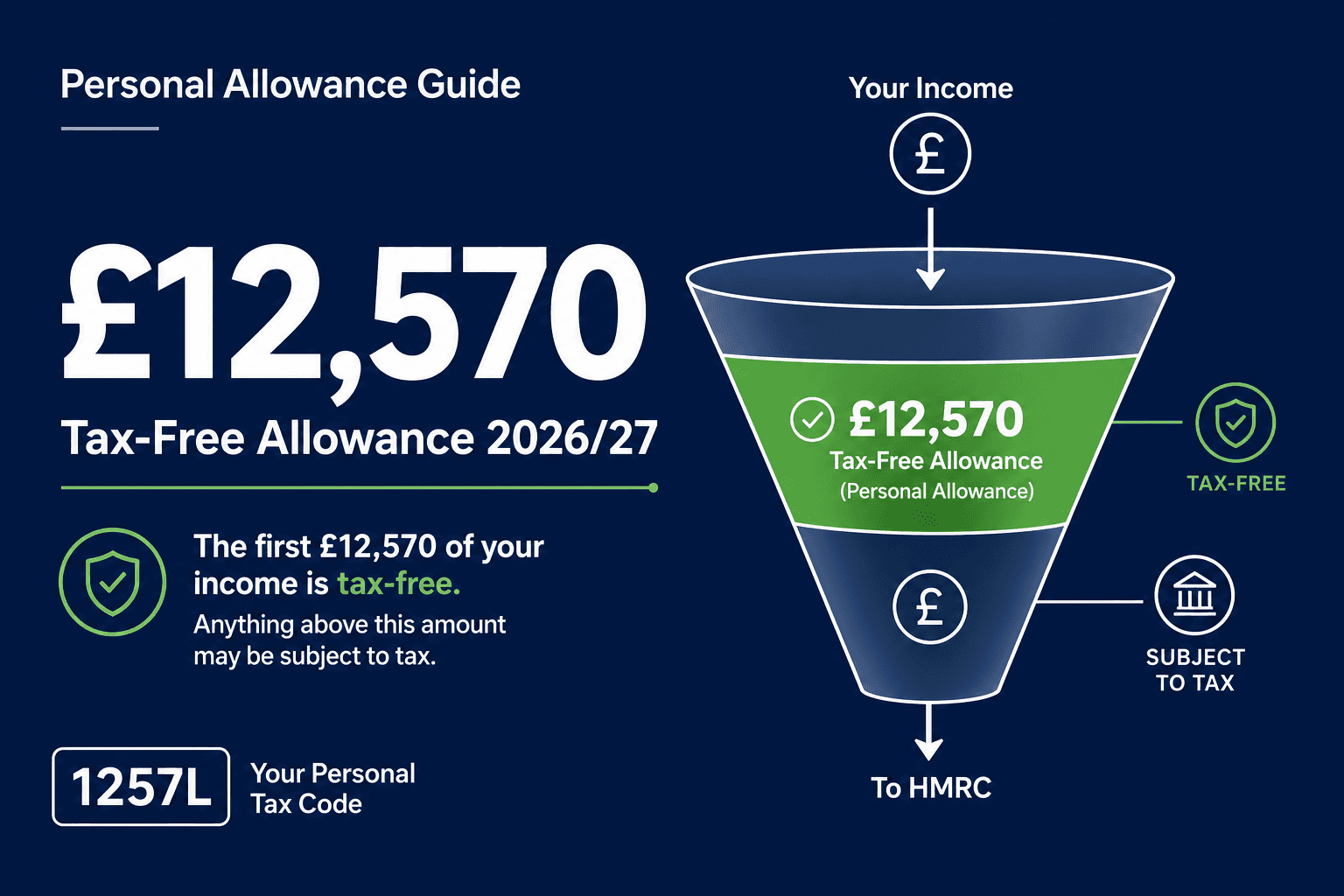
The personal allowance is the amount of income you can earn tax-free each year. For 2026/27 it is £12,570. Here is how it works, when it reduces, and how to make the most of it.
At a glance
- ✓The 2026/27 personal allowance is £12,570 — unchanged since 2021/22
- ✓It reduces by £1 for every £2 earned above £100,000
- ✓You lose it entirely if your income exceeds £125,140
- ✓Marriage Allowance lets a lower-earning partner transfer £1,260 to their spouse
£12,570
Personal allowance
£100,000
Taper starts
£125,140
Fully withdrawn at
Scottish taxpayers pay different rates — see our Scottish income tax guide.
How the personal allowance works
Every UK resident gets a personal allowance — an amount of income that is completely free of income tax. For 2026/27, this is £12,570 per year, which works out at £1,047.50 per month or £241.73 per week.
Your employer uses your tax code to give you the benefit of your personal allowance automatically through PAYE. The most common tax code is 1257L — the "1257" represents £12,570 (divided by 10), and the "L" indicates you have the standard personal allowance.
The personal allowance is applied to your income in a specific order: non-savings income (wages, self-employment profits, pension income, rental income) first, then savings income (bank interest), then dividend income. This ordering generally minimises your tax bill as savings and dividends have their own preferential rates.
Example: how the allowance reduces your bill
If you earn £28,000 in salary:
Without the personal allowance you would owe £5,600 in income tax — the allowance saves you £2,514.
The £100,000 income trap
Effective 60% tax rate between £100,000 and £125,140
Once your adjusted net income exceeds £100,000, your personal allowance is reduced by £1 for every £2 of extra income. On each £2 you earn above £100,000, you pay 40p in higher rate tax plus lose £1 of allowance, which itself would have been taxed at 40% — totalling 60p tax on each £2, or an effective rate of 60%.
Adjusted net income is your total income minus pension contributions and Gift Aid donations. This means you can often reduce your adjusted net income below £100,000 by making pension contributions — potentially saving thousands in tax while boosting your retirement fund.
How pension contributions restore the allowance
If your income is £110,000 and you contribute £10,000 to a pension:
This can save over £5,000 in income tax on top of the pension tax relief itself.
Other allowances that sit alongside the personal allowance
Marriage Allowance — up to £252/yr
Transfer £1,260 of unused personal allowance to your spouse or civil partner. Available if one of you earns below £12,570 and the other is a basic rate taxpayer.
Blind Person's Allowance — £3,070
Registered blind or severely sight-impaired? You get an additional £3,070 on top of your personal allowance. If unused, it can be transferred to a partner.
Savings Allowance
Basic rate taxpayers can earn £1,000 in savings interest tax-free; higher rate taxpayers get £500. Additional rate taxpayers get no savings allowance.
Dividend Allowance — £500
The first £500 of dividend income is tax-free. Above this you pay dividend tax at 8.75% (basic), 33.75% (higher) or 39.35% (additional rate).
Trading / Property Allowance — £1,000 each
Earn up to £1,000 from casual trading or property rental without paying tax or filing a return. Using this means you cannot also deduct actual expenses.
Rent-a-Room Relief — £7,500
Let furnished rooms in your home and receive up to £7,500 per year tax-free. Shared between joint owners.
Frequently asked questions
What is the personal allowance for 2026/27?
The personal allowance for 2026/27 is £12,570. This is the amount of income you can earn each tax year before paying any income tax. It has been frozen at this level since 2021/22.
What happens to the personal allowance above £100,000?
If your adjusted net income exceeds £100,000, your personal allowance is reduced by £1 for every £2 over the threshold. By the time your income reaches £125,140, the personal allowance is fully withdrawn, resulting in an effective 60% marginal tax rate in this income range.
Can I transfer my personal allowance to my partner?
If you are married or in a civil partnership, and one partner's income is below the personal allowance, they can transfer £1,260 of their allowance to the other partner via the Marriage Allowance scheme, saving up to £252 per year.
Do I get a personal allowance on all types of income?
The personal allowance applies to all non-savings income (salary, self-employment, rental income) first, then savings income, then dividend income. It is a single allowance shared across all income sources, not a separate allowance per source.
Sources
Are you using your full allowance?
Our salary calculator shows your full tax breakdown — including whether your tax code is giving you the right allowance.