Tax Codes Explained
Last updated 11/06/2026
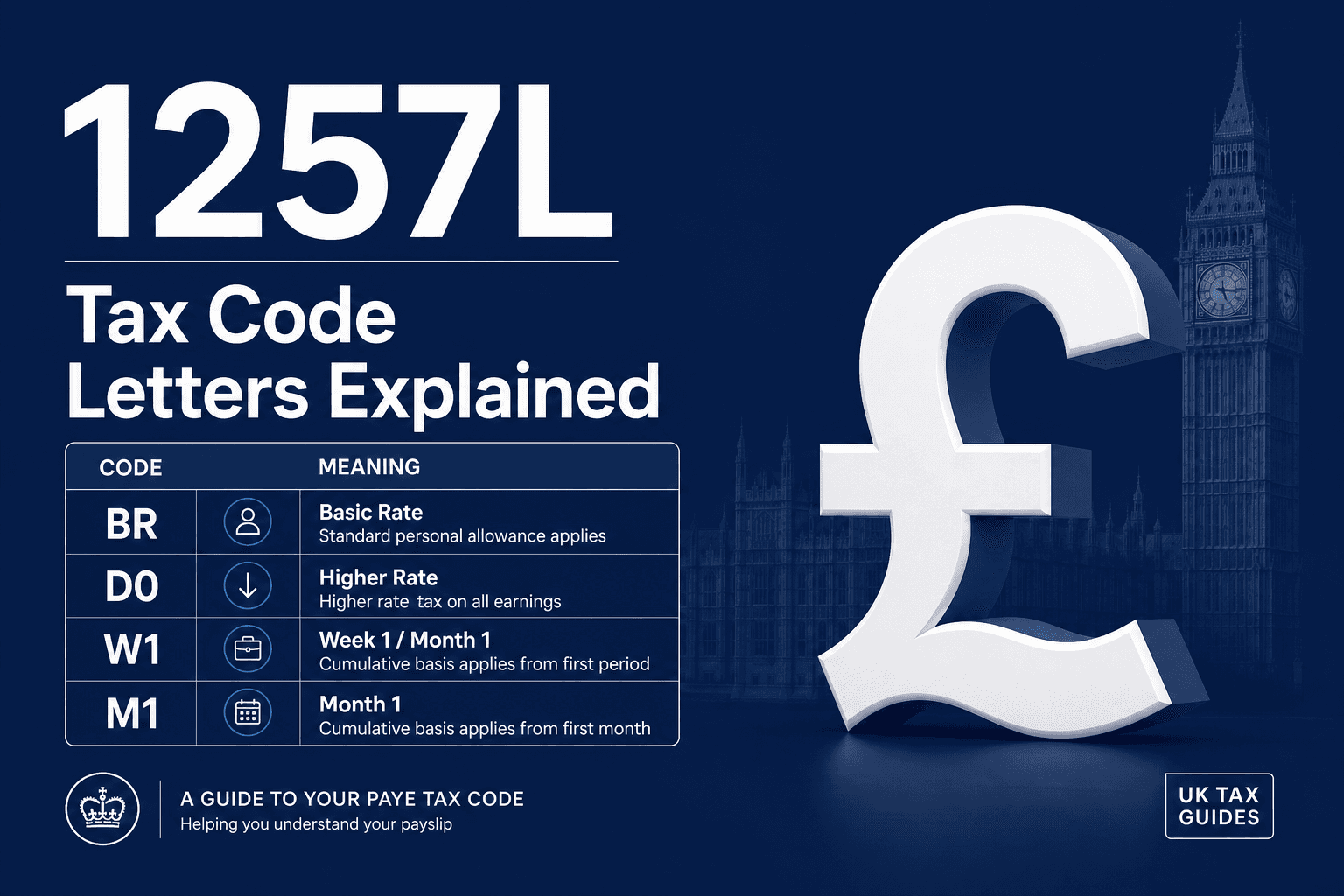
Your tax code is the instruction HMRC sends to your employer telling them how much income tax to deduct from your pay. Most people never think about it — until they notice they have paid too much or too little tax. Here is everything you need to know.
How to Read Your Tax Code
A typical code looks like 1257L. The number and the letter each have a specific meaning:
- The number represents your tax-free allowance divided by 10. So 1257 means £12,570 of tax-free income per year — the standard Personal Allowance for 2026/27.
- The letter describes how HMRC has adjusted your allowances (see below).
What the Letter Means
| Letter | Meaning |
|---|---|
| L | You are entitled to the standard Personal Allowance |
| M | You have received 10% of your partner's Personal Allowance via Marriage Allowance |
| N | You have transferred 10% of your Personal Allowance to your partner |
| T | HMRC needs to review your tax code (various reasons) |
| BR | All income taxed at basic rate (20%) — no personal allowance applied. Common for second jobs or pensions. |
| D0 | All income taxed at higher rate (40%) |
| D1 | All income taxed at additional rate (45%) |
| NT | No tax to be deducted |
| 0T | No personal allowance. Used when all allowances are used up or on a new job with no P45. |
| K | Your deductions exceed your allowances (e.g. unpaid tax from a previous year). Tax is added to your income rather than deducted from allowances. |
| S prefix | You pay Scottish Income Tax rates (e.g. S1257L) |
| C prefix | You pay Welsh Income Tax rates (C1257L) — currently same rates as England |
Emergency Tax Codes
If you start a new job without providing a P45, or if HMRC does not have up-to-date information, you may be put on an emergency tax code. These look like 1257L W1 or 1257L M1 (or simply 1257L X for weekly/monthly basis).
The W1/M1 suffix means your employer calculates tax on a non-cumulative basis — each pay period is treated independently rather than looking at your total pay for the year so far. This can mean you overpay tax if your income varies or you joined mid-year.
Once HMRC processes your P45 or self-assessment information, your code should be updated. Any overpayment is usually refunded through your pay automatically or via a P800 refund letter at year end.
The Personal Allowance Taper
If your income exceeds £100,000, your Personal Allowance is gradually reduced — by £1 for every £2 earned above £100,000. Once your income reaches £125,140, your allowance is zero. HMRC reflects this in your tax code with a lower number (e.g. 500L means £5,000 personal allowance remaining).
K Codes
A K code means you have deductions that exceed your personal allowance. This can happen when:
- You owe tax from a previous year
- You have taxable benefits in kind (e.g. company car) worth more than your allowances
- You receive a state pension that exceeds your allowance
With a K code, your employer adds a notional amount to your pay before calculating tax. There is a 50% regulatory limit — your employer cannot deduct more than 50% of your pay in tax under a K code.
Marriage Allowance
If you are married or in a civil partnership and one partner earns below the Personal Allowance (£12,570) while the other is a basic-rate taxpayer, the lower earner can transfer 10% of their Personal Allowance to their partner. This saves around £252 per year in tax. The receiving partner gets the M suffix; the transferring partner gets N.
Why Your Tax Code Might Be Wrong
- Multiple jobs — only one source of income should get the full personal allowance. Others should be BR or D0.
- Company benefits — benefits in kind (car, private medical insurance) are estimated and included in your code, but estimates can be wrong.
- Underpaid tax from a previous year — HMRC may claw this back via a lower tax code.
- Working from home or other allowances — these might not have been applied correctly.
- Income from savings, property or self-employment — HMRC may adjust your code to collect tax on other income sources.
- Out-of-date information — a change in job or income that HMRC has not yet processed.
- Emergency code left in place — if your new employer never received your P45.
How to Check and Correct Your Tax Code
The quickest way to check your current tax code is via your Personal Tax Account on gov.uk. You can also see it on:
- Your payslip
- Your P60 (issued by your employer at the end of each tax year)
- A P2 coding notice from HMRC (sent when your code changes)
If your code is wrong, you can update it directly in your Personal Tax Account, or call HMRC on 0300 200 3300. If you have overpaid tax, HMRC will typically issue a P800 refund at the end of the tax year, though you can claim earlier.