Understanding Your Payslip
Last updated 11/06/2026
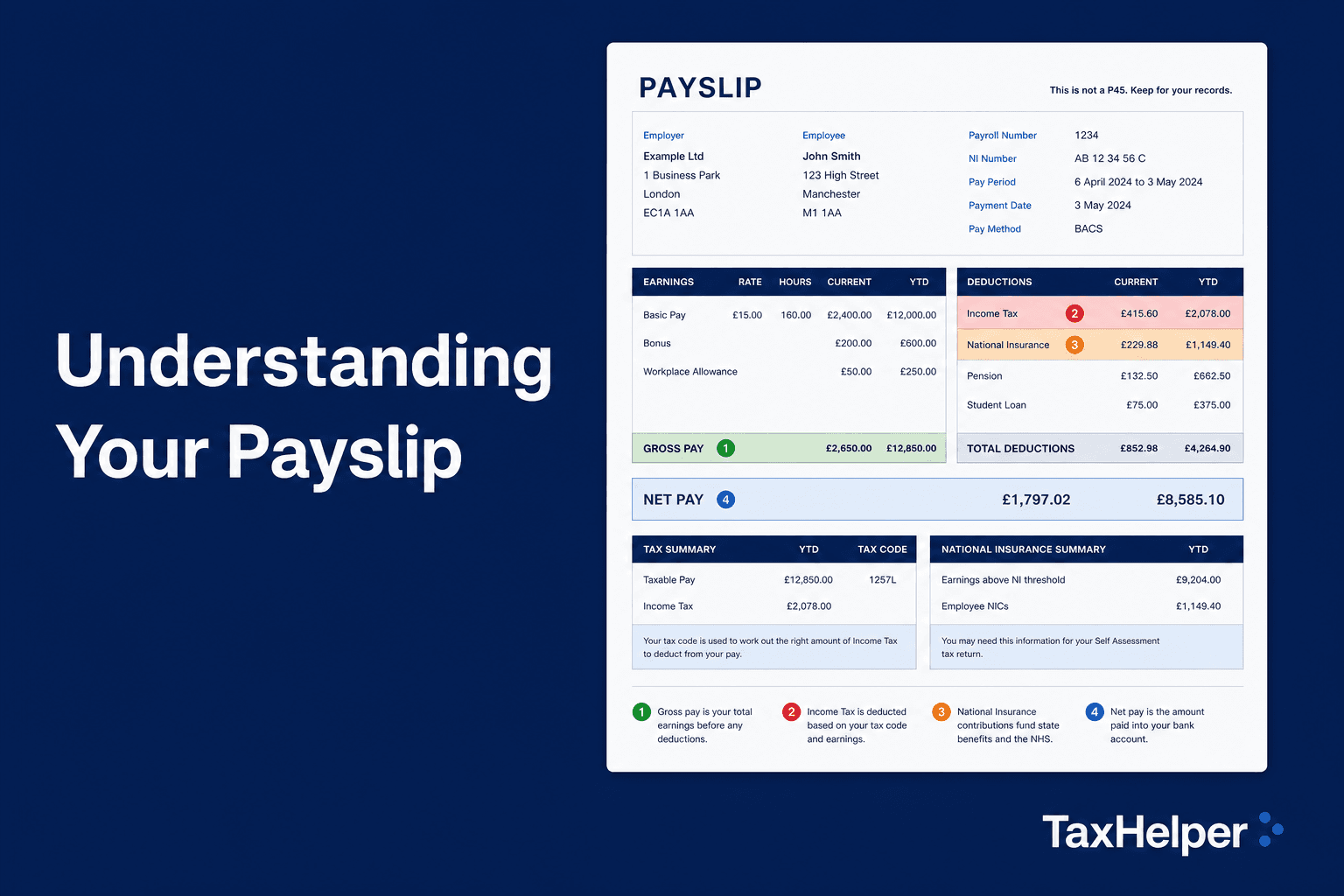
Your payslip is a legal document your employer must provide every time you are paid. It can look daunting, but every line has a clear meaning. This guide walks through each section so you can check your pay is correct.
Gross Pay
Gross pay is your total earnings before any deductions. If you are salaried at £35,000 per year and paid monthly, your gross pay will be £2,916.67 each month. It includes:
- Basic salary
- Overtime and bonuses (where applicable)
- Commission
- Statutory pay (SSP, SMP, SPP)
Taxable Pay
Taxable pay is the portion of your gross pay that income tax is calculated on. It may be lower than gross if you have a salary-sacrifice pension — because those contributions are deducted before tax is calculated, reducing your taxable income immediately.
For example, if your gross pay is £2,916.67 and you contribute £145.83 via salary sacrifice, your taxable pay drops to £2,770.84.
Tax Code
Your tax code tells your employer how much personal allowance to give you. The most common code is 1257L, which means you can earn £12,570 per year tax-free (1257 × 10). The letter after the number tells HMRC how to apply the allowance:
- L — standard personal allowance
- M / N — marriage allowance transferred to/from a spouse
- BR — basic rate (20%) on all income, no personal allowance (common for second jobs)
- D0 / D1 — higher (40%) or additional rate (45%) on all income
- 0T — no personal allowance (e.g. you have used it up elsewhere)
- W1 / M1 — emergency basis, month-by-month rather than cumulative
If your tax code looks wrong, contact HMRC or check your Personal Tax Account at gov.uk.
Income Tax
Income tax is calculated on your taxable pay above your personal allowance. The rates for England, Wales and Northern Ireland in 2026/27 are:
| Band | Taxable income | Rate |
|---|---|---|
| Personal Allowance | Up to £12,570 | 0% |
| Basic rate | £12,571–£50,270 | 20% |
| Higher rate | £50,271–£125,140 | 40% |
| Additional rate | Over £125,140 | 45% |
Your employer calculates this cumulatively across the tax year, so if you receive a bonus one month your tax will be higher, but it usually corrects itself by year end.
Scottish taxpayers pay different rates. Scotland has five bands (19%, 20%, 21%, 42% and 45%) — look for an S prefix in your tax code (e.g. S1257L).
National Insurance
National Insurance (NI) is a separate deduction from income tax. Your payslip shows your NI category letter — most employees are category A. The 2026/27 employee rates are:
| Earnings | Rate (Category A) |
|---|---|
| Up to £12,570/yr (Primary Threshold) | 0% |
| £12,571–£50,270/yr (up to Upper Earnings Limit) | 8% |
| Over £50,270/yr | 2% |
NI funds the state pension, NHS and other benefits. Unlike income tax, NI is calculated each pay period independently — there is no cumulative adjustment. Special categories exist for: married women with a reduced-rate election (B), over state pension age (C), and deferral (D).
Pension Contributions
If your employer runs a workplace pension, you will see a pension deduction. Under auto-enrolment, the minimum total contribution is 8% of qualifying earnings, with at least 3% coming from your employer.
There are two main methods:
- Salary sacrifice — your contribution is taken before tax and NI, so you save both. Shown as a reduction to gross pay before tax is calculated.
- Relief at source (RAS) — your contribution is taken from net pay, and the pension provider claims 20% tax relief from HMRC on your behalf, grossing up your contribution automatically.
The employee contribution percentage is often shown separately from the employer contribution. The employer contribution does not appear as a deduction — it is extra money that goes into your pot at no cost to you.
Student Loan
If you have a student loan and earn above the repayment threshold, your employer deducts repayments automatically via PAYE. The thresholds and rates for 2026/27 are:
| Plan | Annual threshold | Rate above threshold |
|---|---|---|
| Plan 1 (pre-Sept 2012) | £24,990 | 9% |
| Plan 2 (post-Sept 2012) | £27,295 | 9% |
| Plan 4 (Scotland) | £31,395 | 9% |
| Plan 5 (from Aug 2023) | £25,000 | 9% |
| Postgraduate Loan | £21,000 | 6% |
Repayments are calculated on your earnings above the threshold, not your total income.
Net Pay (Take-Home Pay)
Your net pay is what ends up in your bank account: gross pay minus income tax, minus NI, minus pension (if not salary sacrifice), minus student loan, minus any other voluntary deductions.
Year-to-Date Figures
Most payslips also show cumulative year-to-date (YTD) totals. These are useful for checking your overall tax position and should match your P60 at the end of the tax year (5 April).
Checking Your Payslip
Use our salary calculator to verify your expected take-home for your gross salary. If the numbers differ significantly, check:
- Your tax code is correct
- No emergency (W1/M1) code is applied unnecessarily
- Your NI category is right (most people should be A)
- Pension contributions are the percentage you agreed
If you believe your tax code is wrong, you can update it via your Personal Tax Account on gov.uk or by calling HMRC on 0300 200 3300.