High Income Child Benefit Charge
Last reviewed: April 2026
If your household income exceeds £60,000 and you or your partner receive Child Benefit, you may owe a tax charge. Here is how it works, how much you owe, and the options to reduce or eliminate it.
At a glance
- ✓The charge starts at £60,000 of adjusted net income and reaches 100% at £80,000
- ✓It is 1% of Child Benefit received per £200 of income above £60,000
- ✓You must declare it via Self Assessment — it cannot be collected automatically via PAYE
- ✓Opting out of Child Benefit payments avoids the charge but you should still file the claim
How the charge is calculated
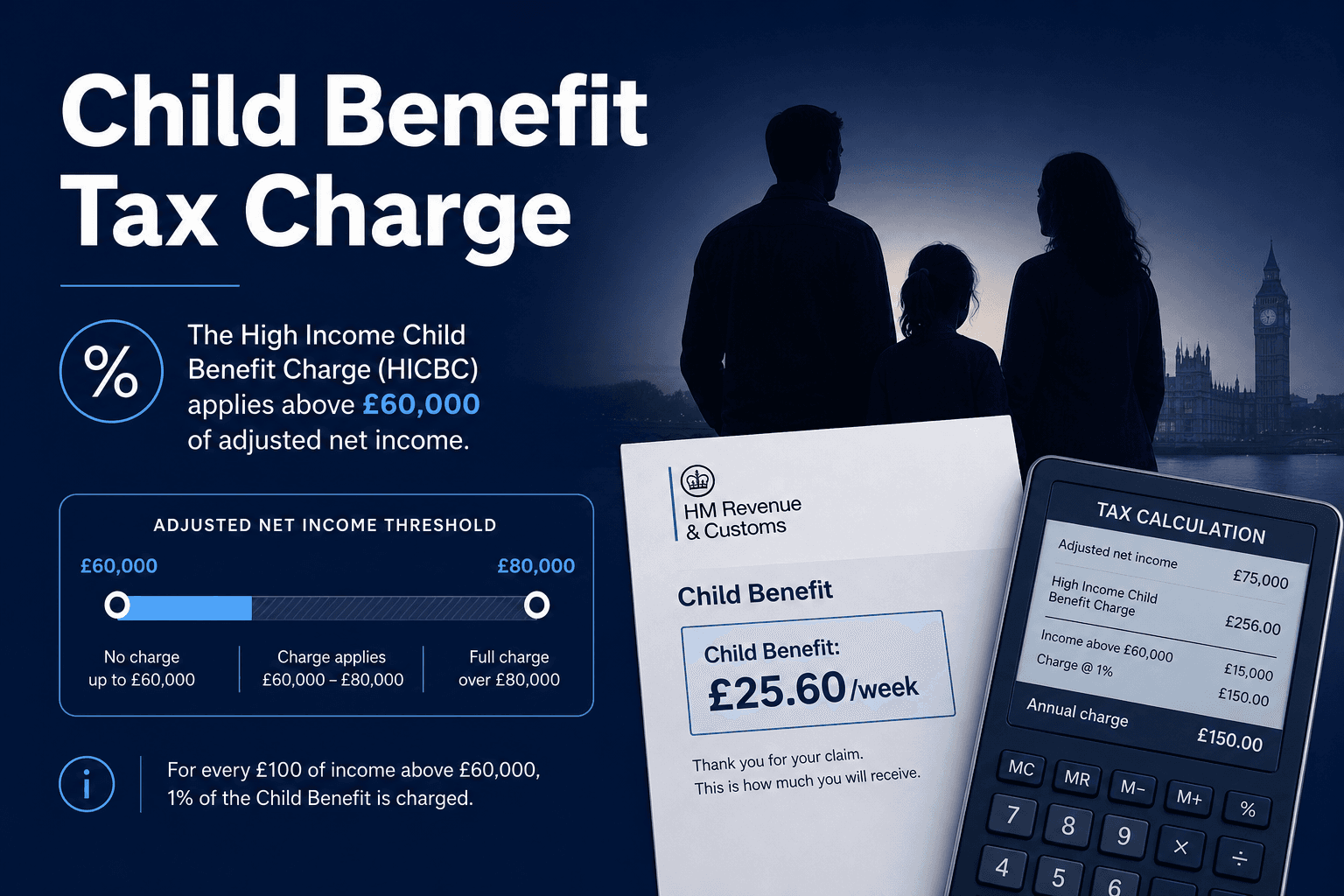
The High Income Child Benefit Tax Charge (HICBC) is 1% of the total Child Benefit you or your partner received for every £200 your adjusted net income exceeds £60,000.
Adjusted net income is your gross income minus pension contributions, Gift Aid donations, and certain other reliefs. Reducing your adjusted net income below £60,000 removes the charge entirely.
| Adjusted net income | Charge rate | Child Benefit kept |
|---|---|---|
| Up to £60,000 | 0% | 100% |
| £62,000 | 10% | 90% |
| £65,000 | 25% | 75% |
| £70,000 | 50% | 50% |
| £75,000 | 75% | 25% |
| £80,000 or more | 100% | 0% |
Worked example
Scenario: Two children, £70,000 salary.
- Child Benefit for 2 children: 2026/27 rate ≈ £25.60/week (eldest) + £16.95/week (additional) = £42.55/week = £2,212.60/year
- Income above £60,000: £70,000 − £60,000 = £10,000
- Charge rate: £10,000 ÷ £200 = 50 × 1% = 50%
- Charge owed: £2,212.60 × 50% = £1,106.30
- Net Child Benefit received: £2,212.60 − £1,106.30 = £1,106.30
How to reduce or avoid the charge
Increase pension contributions
Contributions to a registered pension scheme reduce your adjusted net income. An extra £10,000 contribution on a £70,000 salary brings you under £60,000, eliminating the charge entirely.
Make Gift Aid donations
Qualifying charitable donations reduce adjusted net income on the same basis as pension contributions. Keep records to declare on your Self Assessment return.
Opt out of Child Benefit payments
You can ask HMRC to stop Child Benefit payments. No payments = no charge. But you must still complete the claim to protect NI credits and your child's NI number entitlement.
Register for Self Assessment
If you are liable, you must register by 5 October after the tax year ends. Missing this triggers penalties on top of the charge.
Important: The charge applies to adjusted net income, not just your employment income. Include rental income, savings interest, and dividends when checking whether you are liable.
Common questions
At what income does the High Income Child Benefit Charge kick in?
The charge applies once your adjusted net income exceeds £60,000 in a tax year. It is 1% of the Child Benefit received for every £200 of income above £60,000, reaching 100% at £80,000.
Can I avoid the charge by not claiming Child Benefit?
Yes. You can opt out of receiving Child Benefit payments, which means no charge arises. However, you should still complete the Child Benefit claim form to protect your National Insurance record and your child's eligibility for a National Insurance number.
Does the charge apply to the lower-earning partner?
The charge falls on whoever in the household earns over the threshold — even if they are not the person who claimed Child Benefit. Both partners' incomes are assessed separately; the one who earns most above £60,000 pays the charge.
How do I pay the High Income Child Benefit Charge?
You must register for Self Assessment and declare it on your tax return. HMRC cannot collect it through PAYE unless you ask them to adjust your tax code.
Sources
Check your Self Assessment deadlines
If you owe the High Income Child Benefit Charge, you must file via Self Assessment. See all key dates at a glance.
Self Assessment deadlines